Modified Bitumen Roofing in Huntsville, AL — What to Expect
Modified bitumen is asphalt reinforced with polymer and reinforcing fabric, installed in two or more plies. The multi-ply build gives it puncture resistance that a single-ply membrane cannot match, which matters on a roof that gets walked regularly for equipment service.
It comes in torch-applied, hot-mopped, cold-adhesive and self-adhering versions. On an occupied building we generally avoid open-flame application entirely — the fire risk on a job over a working tenant space is not worth the small saving, and self-adhering and cold-applied systems have closed most of the performance gap.
If your roof carries a lot of rooftop mechanical equipment and technicians on it monthly, this is worth comparing against single-ply seriously rather than treating it as the old-fashioned option.
What Is Included
- Two-ply and three-ply assemblies with polymer-modified sheets
- Self-adhering and cold-applied options on occupied buildings
- Granulated cap sheet for UV and foot-traffic durability
- Redundancy — a puncture through one ply is not through the roof
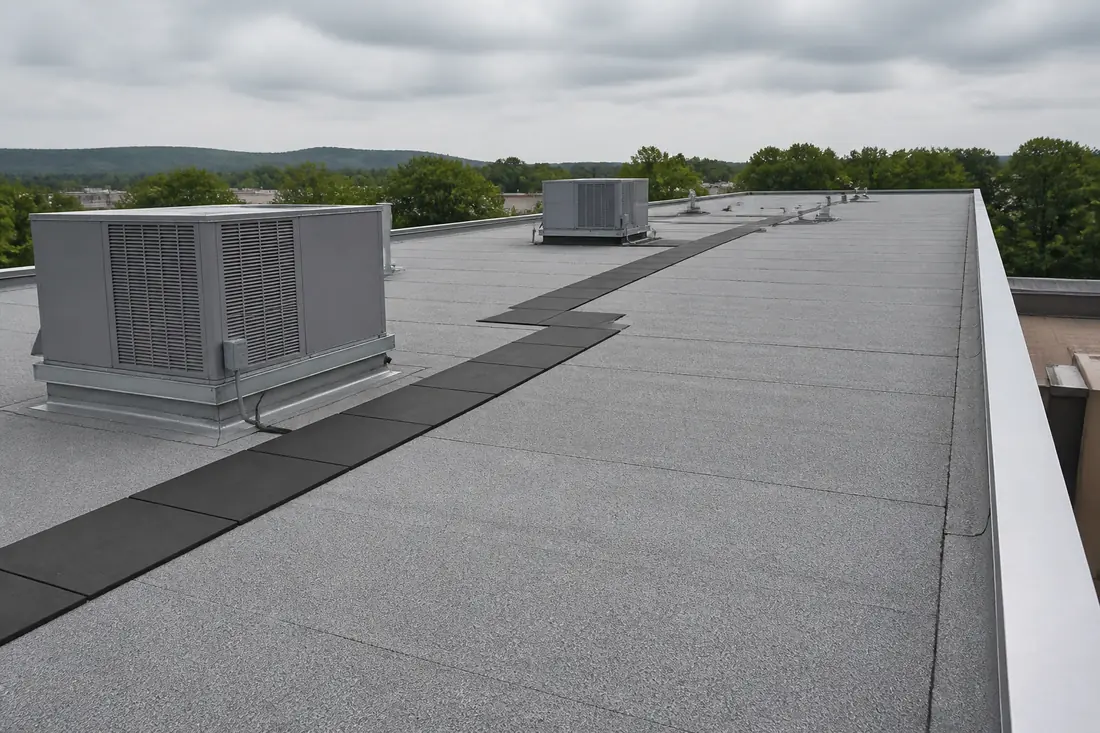
- Reinforced walkway pads at service routes and equipment
- Compatible with existing modified bitumen and built-up roofs
Our Process for Modified Bitumen Roofing
- 1
Step 1: Traffic and Equipment Survey
We look at how the roof is actually used — where technicians walk, what equipment gets serviced, how often. That is what makes the case for a multi-ply system over a single-ply.
- 2
Step 2: Ply Configuration and Application Method
Two-ply or three-ply is specified along with the application method. On occupied buildings we plan around self-adhering or cold-applied rather than open flame.
- 3
Step 3: Substrate Preparation and Base Sheet
Substrate prepared and the base sheet installed and fastened, giving a sound and consistent surface for the plies above.
- 4
Step 4: Ply and Cap Sheet Installation
Interply and cap sheet installed with laps staggered so no two plies terminate on the same line, which is what makes the assembly redundant rather than just thick.
- 5
Step 5: Flashing, Walkways and Detailing
Base and counter flashing built at every curb and wall, and reinforced walkway pads set along the routes technicians actually use.
Modified Bitumen Roofing We Offer in Huntsville
Two-Ply Modified Bitumen
Base sheet and granulated cap. The standard specification, giving redundancy at moderate cost.
Three-Ply Systems
An additional interply for roofs with heavy traffic or where the longest possible service life is the priority.
Self-Adhering (Peel-and-Stick)
No torch and no kettle, which removes the fire risk entirely. Our default on occupied buildings and anywhere open flame is unwelcome.
Cold-Applied Systems
Plies set in cold adhesive — no flame, no fumes from a kettle, and suitable where hot work permits are difficult to obtain.
Why We Are the Roof Systems Contractor to Call in Huntsville, AL
We work around your operations
Occupied buildings do not stop for a roof. Phasing, night and weekend work, and protection of what is underneath are planned before mobilisation, not improvised on day one.
Drainage assessed before membrane
Most premature membrane failure we are called to is a drainage problem wearing a membrane costume. Slope, drains and scuppers get surveyed before anyone specifies a system.
Written scope, photographed condition
You get a documented scope and photographs of what was found and what was done, which is what a facility manager needs for a capital file and an insurer needs for a claim.
Installed to manufacturer specification
Fastener patterns, seam widths and flashing details follow the system manufacturer’s published requirements, because that is what a material warranty is conditioned on.
Repair quoted against replacement
When a roof is near end of life we price the repair and the replacement side by side with remaining service life on each, rather than selling whichever is larger.
Clean sites, protected tenants
Debris containment, magnet sweeps and protected walkways matter more on an occupied retail or medical building than on any residential job.
Modified Bitumen Roofing FAQs
Is torch-down roofing safe on an occupied building?
It is done, with hot work permits, fire watch and extinguishers on the roof — but we generally avoid it over an occupied space. Self-adhering and cold-applied systems perform comparably and remove the risk entirely, and the cost difference is small against what a fire costs.
How does modified bitumen compare to single-ply?
It resists punctures far better because there is more than one layer between the weather and your deck, which matters on a roof walked regularly. Single-ply is lighter, faster to install and usually cheaper. Rooftop equipment traffic is the deciding factor.
How long does a modified bitumen roof last?
A properly installed multi-ply system is long-lived, and the granulated cap sheet protects the plies from UV. As with any low-slope roof, drainage and maintenance decide the outcome more than the material specification does.
Can modified bitumen go over my existing built-up roof?
Often yes — the materials are compatible and a mod bit cap over a sound BUR is a recognised recover. It depends on the existing roof being dry and the building carrying the extra weight, both of which we check first.
What are walkway pads and do I need them?
Reinforced pads laid along the routes to rooftop equipment. They take the abrasion and point loads from foot traffic instead of the cap sheet. On any roof with serviced equipment they are cheap insurance and are routinely left out of low bids.
Other Services in Huntsville
- Preventive Maintenance ProgramsScheduled inspection, drain clearing and minor repair — the cheapest roof spending you will ever do.
- Emergency Roof ResponseRapid temporary stabilisation of active leaks and storm damage to stop losses inside the building.
- Commercial Roof RepairTargeted repair of seams, flashings, penetrations and membrane damage — after establishing why it failed.