Roof Drainage Systems in Huntsville, AL — What to Expect
Standing water is the single most destructive thing on a low-slope roof. It magnifies UV damage, adds dead load, breeds growth, and finds any weakness in a seam. A roof that drains properly outlives an identical roof that does not by years.
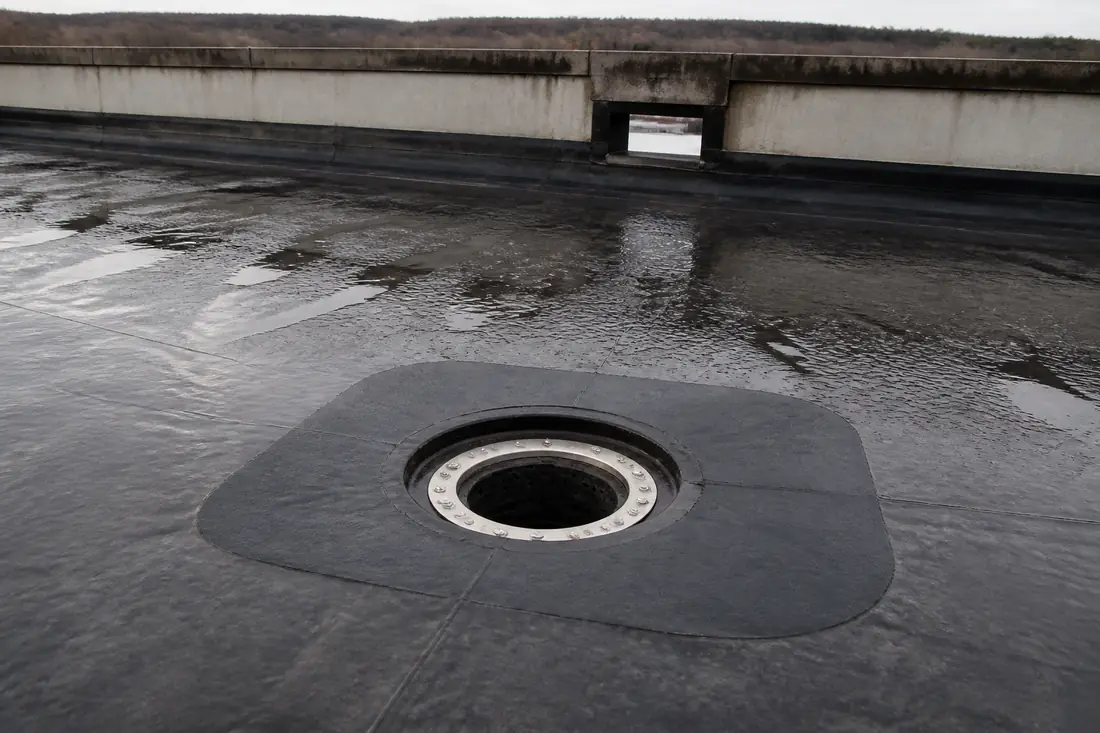
Primary drainage on a commercial building is usually internal drains piped through the building, or a perimeter gutter. Scuppers through the parapet are most often secondary — overflow provision that only activates when the primary drains block or are overwhelmed. Confusing the two is common and dangerous, because a building relying on blocked primaries with no working overflow can accumulate serious load.
Most of our drainage work is unglamorous: clearing blocked drains, replacing failed drain bowls and clamping rings, rebuilding sumps, and adding overflow where a roof has none. It is also some of the highest-value work we do, measured against what a ponding roof costs.
What Is Included
- Internal drain repair, replacement and sump rebuild
- Through-wall scupper installation and repair
- Overflow provision where a roof has no secondary drainage
- Drain bowl, clamping ring and strainer replacement
- Blocked drain and debris clearing
- Drainage assessed against the roof area it has to serve
Our Process for Roof Drainage Systems
- 1
Step 1: Drainage Assessment Against Roof Area
We establish how much roof area each drain and scupper actually serves, and whether that provision is adequate. Undersized drainage is common on buildings that have been extended.
- 2
Step 2: Ponding Survey After Rainfall
Where possible the roof is surveyed after rain, when standing water shows the low points directly rather than being inferred from slope measurements.
- 3
Step 3: Primary and Secondary Provision Checked
We confirm what is primary drainage and what is overflow. A building relying on blocked primaries with no working secondary can accumulate serious load in one storm.
- 4
Step 4: Repair, Replacement or New Provision
Drain bowls, clamping rings and strainers replaced, sumps rebuilt, scuppers cut and flashed, or new overflow provision added where the roof has none.
- 5
Step 5: Flow Testing and Verification
Drains are flow-tested to confirm they run clear and that the sump and surrounding membrane are properly sealed to the drain assembly.
Roof Drainage Systems We Offer in Huntsville
Internal Roof Drain Repair and Replacement
Drain bowls, clamping rings, strainer domes and sump rebuild — the assembly where the membrane terminates into the drain.
Through-Wall Scuppers and Overflow
Cutting, lining and flashing scuppers through parapet walls, most often as the secondary drainage a roof is missing.
Drain Clearing and Debris Removal
Clearing blocked drains, strainers and sumps. Unglamorous, cheap, and the highest-return work on this list.
Sump and Tapered Drain Detailing
Building a proper sump around a drain so water actually reaches it, rather than sitting in a ring just outside it.
Why We Are the Drainage and Exterior Contractor to Call in Huntsville, AL
We work around your operations
Occupied buildings do not stop for a roof. Phasing, night and weekend work, and protection of what is underneath are planned before mobilisation, not improvised on day one.
Drainage assessed before membrane
Most premature membrane failure we are called to is a drainage problem wearing a membrane costume. Slope, drains and scuppers get surveyed before anyone specifies a system.
Written scope, photographed condition
You get a documented scope and photographs of what was found and what was done, which is what a facility manager needs for a capital file and an insurer needs for a claim.
Installed to manufacturer specification
Fastener patterns, seam widths and flashing details follow the system manufacturer’s published requirements, because that is what a material warranty is conditioned on.
Repair quoted against replacement
When a roof is near end of life we price the repair and the replacement side by side with remaining service life on each, rather than selling whichever is larger.
Clean sites, protected tenants
Debris containment, magnet sweeps and protected walkways matter more on an occupied retail or medical building than on any residential job.
Roof Drainage Systems FAQs
How quickly should water drain off a flat roof?
The usual benchmark is that standing water should be gone within about 48 hours of rain stopping. Beyond that it counts as ponding, and most manufacturers exclude ponding-related damage from their warranties.
What is the difference between a drain and a scupper?
A drain sits in the roof field and pipes water down through the building. A scupper is an opening through the parapet that lets water out at the edge. On most commercial buildings scuppers are secondary — overflow that activates only when the primary drains block or are overwhelmed.
Does my roof need overflow drainage?
If the primary drains can block — and they all can — then yes, the building needs somewhere for water to go before load becomes a structural problem. A surprising number of roofs we survey have no working secondary provision at all.
How much weight does standing water add?
Water weighs a little over five pounds per square foot per inch of depth. An inch across a large roof is a great deal of load, and deflection makes it worse: the roof sags where water collects, so more water collects there. That is how ponding becomes progressive.
How often should drains be cleared?
At least twice a year, more where there is tree cover. It is the cheapest roof maintenance that exists and the most frequently skipped, and a blocked drain in a heavy storm can do damage out of all proportion to what clearing it would have cost.
Other Services in Huntsville
- Built-Up Roofing (BUR)Traditional multi-ply built-up roofing — alternating bitumen and reinforcing felts with a gravel or cap surfacing.
- Commercial Metal RoofingStanding seam and exposed-fastener metal roofing for warehouses, agricultural buildings and steep-slope commercial.
- Roof Replacement and Tear-OffFull removal down to deck, deck repair, and a new roof assembly — phased so the building keeps operating.