TPO Roofing in Huntsville, AL — What to Expect
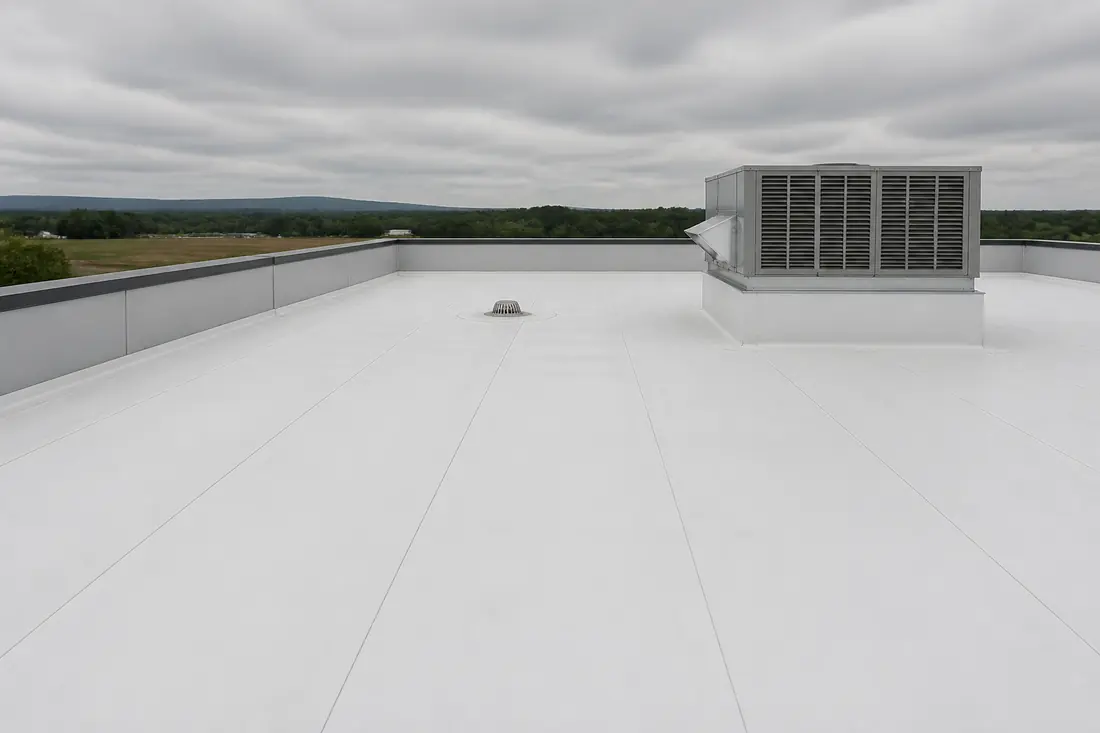
TPO is a single-ply thermoplastic membrane whose seams are heat-welded rather than glued, which is why it has taken over most of the commercial market. A properly welded seam is as strong as the sheet either side of it, and it does not depend on an adhesive that ages at a different rate to the membrane.
The reflective white surface matters in Alabama. A dark roof on a conditioned building in a Huntsville August drives cooling load and ages the membrane faster. TPO reflects most of that back, which is why it appears in nearly every new-build specification we see here.
Where TPO goes wrong is almost always workmanship rather than material. Welds run too cold or too fast do not fuse, and the failure shows up two or three years later at a seam rather than immediately. Every weld on our installs is probed, and the roof is walked and probed again before it is called complete.
What Is Included
- Hot-air welded seams, probe-tested across the whole field
- Mechanically attached, fully adhered or induction-welded to suit the deck
- Reflective white membrane to cut summer cooling load
- Detailed flashing at curbs, penetrations and parapet walls
- Insulation and cover board specified for the assembly, not just the membrane
- Manufacturer warranty available on qualifying assemblies
Our Process for TPO Roofing
- 1
Step 1: Roof Survey and Core Sampling
The existing assembly is surveyed and, where warranted, cored to confirm what is actually up there — deck type, insulation, how many roofs, and whether any of it is wet. That determines whether TPO can go over or the roof has to come off.
- 2
Step 2: Assembly and Attachment Design
Membrane thickness, insulation, cover board and attachment method are specified together for your deck and wind zone. Mechanically attached, fully adhered and induction-welded all suit different buildings and are not interchangeable.
- 3
Step 3: Tear-Off or Substrate Preparation
The old roof is removed or the substrate prepared, with deck repairs made as found. Only as much roof is opened in a day as can be made watertight before the crew leaves.
- 4
Step 4: Insulation, Cover Board and Membrane
Insulation and cover board are laid and fastened to the design pattern, then the membrane rolled out, positioned and attached with laps set for welding.
- 5
Step 5: Welding, Probing and Detailing
Seams are hot-air welded, then probed along their full length with a seam probe. Curbs, penetrations and terminations are flashed, and the roof is walked again before handover.
TPO Roofing We Offer in Huntsville
Mechanically Attached TPO
Membrane fastened through to the deck along the laps. Fastest and most economical on a steel deck, with wind uplift resistance set by the fastening pattern.
Fully Adhered TPO
Membrane bonded across its whole area to the substrate. No fluttering, a smoother finished appearance, and the usual choice where wind exposure is high.
Induction-Welded TPO
Plates fastened to the deck and the membrane welded to them electromagnetically from above, giving adhered-level performance without adhesive or penetrating the membrane.
TPO Recover Over Existing Roof
A new TPO system installed over a sound, dry existing roof with a cover board between, avoiding tear-off cost and disruption where the assembly below allows it.
Why We Are the Roof Systems Contractor to Call in Huntsville, AL
We work around your operations
Occupied buildings do not stop for a roof. Phasing, night and weekend work, and protection of what is underneath are planned before mobilisation, not improvised on day one.
Drainage assessed before membrane
Most premature membrane failure we are called to is a drainage problem wearing a membrane costume. Slope, drains and scuppers get surveyed before anyone specifies a system.
Written scope, photographed condition
You get a documented scope and photographs of what was found and what was done, which is what a facility manager needs for a capital file and an insurer needs for a claim.
Installed to manufacturer specification
Fastener patterns, seam widths and flashing details follow the system manufacturer’s published requirements, because that is what a material warranty is conditioned on.
Repair quoted against replacement
When a roof is near end of life we price the repair and the replacement side by side with remaining service life on each, rather than selling whichever is larger.
Clean sites, protected tenants
Debris containment, magnet sweeps and protected walkways matter more on an occupied retail or medical building than on any residential job.
TPO Roofing FAQs
How long does a TPO roof last?
A well-installed TPO roof on a properly drained building runs a long service life, and thicker membranes last longer than thin ones. What actually decides it is drainage and maintenance rather than the brand — the same membrane on a ponding roof will fail years earlier.
Is TPO better than EPDM?
For most new commercial work in this climate, yes, mainly because welded seams outperform adhered ones over time and the reflective surface cuts cooling load. EPDM still has the longer track record and better cold flexibility. The building decides, not the salesman.
Can TPO be installed over my existing roof?
Often, if the existing assembly is dry and structurally sound and the building can carry the additional weight. A moisture survey answers the first question. Recovering over wet insulation seals the water in and shortens the new roof's life.
Why do TPO seams fail?
Nearly always because the weld ran too cold, too hot or too fast. A correct weld fuses the two sheets into one; a marginal one holds initially and opens a couple of years later. That is why every seam on our installs is probed before the roof is signed off.
Does a white roof really reduce cooling costs?
On a conditioned building in an Alabama summer, measurably. A reflective membrane sends most of the solar load back rather than conducting it into the building. The saving depends on your insulation and how hard the building is cooled, but the membrane also runs cooler and ages more slowly.
Other Services in Huntsville
- Roof Drainage SystemsInternal drains, scuppers and overflow provision — designed, repaired and cleared so water leaves the roof.
- Tapered Insulation and Ponding CorrectionBuilding positive slope into a flat roof with tapered insulation and crickets so water reaches the drains.
- Roof Inspections and Condition ReportsDocumented condition assessment with remaining service life — for budgets, due diligence and insurance.